
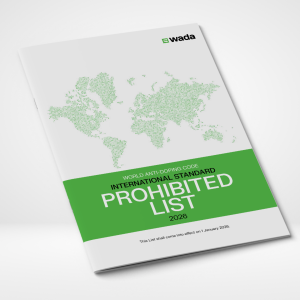
The World Anti-Doping Agency (WADA) published the 2026 List of Prohibited Substances and Methods (List), which was approved by WADA’s Executive Committee (ExCo) during its meeting on 11 September 2025 and enters into force on 1 January 2026.
We also publish:
- the 2026 Summary of Major Modifications and Explanatory Notes as compared to the 2025 List; and
- the 2026 Monitoring Program, which includes substances that are not on the List, but that WADA wishes to monitor in order to detect potential patterns of misuse in sport.
The List is one of the eight International Standards that are mandatory for all Signatories of the World Anti-Doping Code (Code). It designates which substances and methods are prohibited both in- and out-of-competition and which substances are banned in particular sports.
WADA Director General Olivier Niggli said: “We encourage athletes, their entourage and all stakeholders to acquaint themselves with the Summary of Major Modifications to avoid inadvertent use of substances and methods that are prohibited in sport for 2026. In particular, we kindly ask all Anti-Doping Organizations around the world to share the List and its related documents with athletes, their entourage, and other relevant stakeholders under their jurisdiction.
Major modifications for 2026
As outlined in the 2026 Summary of Major Modifications and Explanatory Notes, the major modifications for 2026 include the following:
- Further examples or clarifications have been added to the following substance classes to help athletes and their entourage better identify prohibited substances:
- S1. Anabolic agents,
- S2. Peptide hormones, growth factors, related substances, and mimetics,
- S4. Hormone and metabolic modulators, and
- S6. Stimulants.
- The dosing intervals of salmeterol have been changed to avoid potential ergogenic effects, though the maximum daily delivered dose remains the same.
- More details have been given about the prohibition of withdrawal of blood and blood components.
- The non-diagnostic use of carbon monoxide (CO) has been added to the Prohibited Methods as a new section, M1.4. The use of carbon monoxide for diagnostic purposes, such as total hemoglobin mass measurements or the determination of pulmonary diffusion capacity, is not prohibited.
- Cell components (e.g., nuclei and organelles such as mitochondria and ribosomes) have been added to the existing prohibition of using normal or genetically modified cells.
- It has been clarified in the Glucocorticoids Washout Table that use of sustained-release formulations may result in detectable glucocorticoid levels past the washout period due to prolonged systemic absorption.
Source: https://www.wada-ama.org/en/news/wada-publishes-2026-prohibited-list